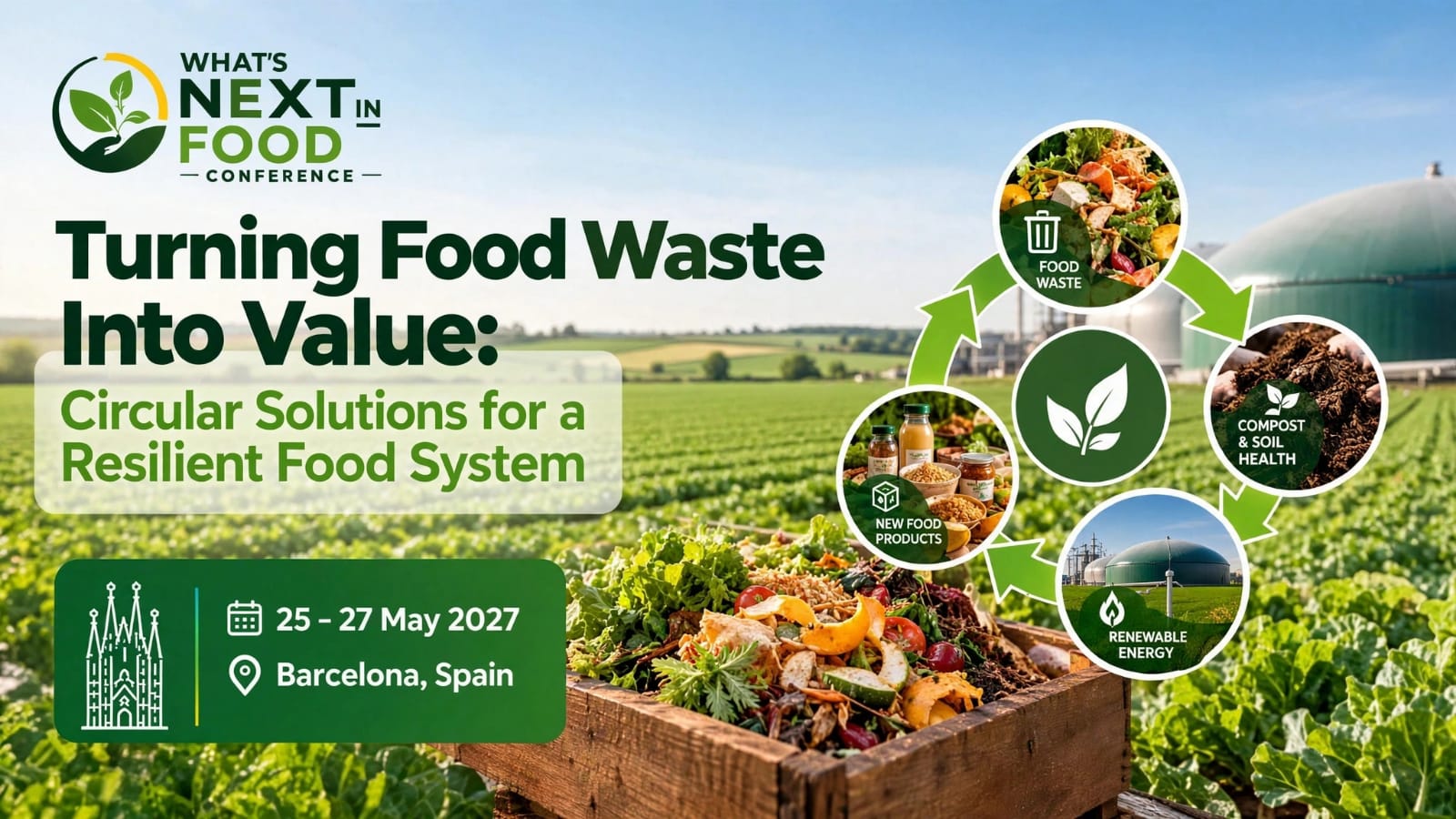
Food waste is no longer only a disposal problem; it is one of the food system’s largest untapped sources of value. In 2022, the world wasted 1.05 billion tones of food, equivalent to roughly one-fifth of the food available to consumers. Food loss and waste also account for an estimated 8–10% of global greenhouse-gas emissions.
A circular approach treats surplus food, processing by-products and unavoidable organic waste as resources. Done well, it can reduce emissions, improve food security, lower costs and create new ingredients, materials and revenue streams.
The scale of the challenge
Food is lost and wasted across the entire supply chain: after harvest, during processing, storage, and transport, and at retail, food-service, and household levels. According to FAO’s latest estimates,13.4% of food produced globally is lost after harvest and before reaching retail, while 19% of food available to consumers is wasted at retail, in food service, and in households.
The most recent comprehensive global food-waste estimate, published by UNEP in its 2024 Food Waste Index Report, found that 1.05 billion tones of food were wasted in 2022. This equated to approximately 132 kg per person and about one-fifth of the food available to consumers. Households accounted for 60% of this waste, food service for 28% and retail for 12%.
Food loss and waste also carries a major climate cost. They are estimated to contribute 8–10% of global greenhouse-gas emissions, while consuming land, water, energy, labor, and nutrients that could otherwise support food security and more resilient food systems.
A circular approach is therefore not simply about managing waste after it occurs. It is about preventing avoidable loss, redirecting edible surplus to people, and converting unavoidable by-products into higher-value inputs for food, feed, materials, and energy.
Why circularity matters
A linear food system follows a simple path: produce, process, consume, discard. A circular food system keeps resources in use for as long as possible through prevention, redistribution, upcycling, and recovery.
The priority order matters. The most valuable food waste is the waste that is never created. Prevention should come first, followed by redistribution of edible surplus for human consumption. Where appropriate and safe, remaining by-products can be converted into food ingredients or animal feed, with energy recovery and other material uses considered for residual waste.
This hierarchy helps businesses avoid treating circularity as a substitute for waste reduction. It also supports global sustainability goals, including Sustainable Development Goal 12.3 , which calls for halving per capita global food waste at retail and consumer levels and reducing food losses along production and supply chains by 2030.
From by-product to business opportunity
Food processing generates large volumes of peels, pulp, husks, spent grains, whey, trimmings, and other side streams. These materials can become ingredients, packaging inputs, animal feed, fertilizers, bioenergy, or biochemicals.
Examples include:
•Fruit and vegetable pomace used for fibers, natural colorants, antioxidants, and snack ingredients.
•Brewer’s spent grain converted into protein-rich flours, animal feed, or bio-based materials.
•Whey from dairy processing used in protein ingredients and functional foods.
•Coffee grounds and tea waste used for extraction, composting, or bioenergy.
•Oilseed meals and crop residues used for feed, fertilizers, or bioplastics.
Upcycling technologies are expanding rapidly, including integrated biorefineries, green extraction, microbial processes, pyrolysis, and conventional bio-waste valorization. The commercial opportunity lies in identifying side streams with stable volume, consistent quality, and a credible route to market.
However, not every by-product can be converted profitably. Businesses must assess food safety, contamination risks, processing requirements, regulatory compliance and market demand before investing in new recovery systems.
Technology is making circularity scalable
Digital tools are helping food businesses identify waste more accurately and intervene earlier. AI-based forecasting can help reduce overproduction, while computer vision can detect quality defects on processing lines. Internet of Things (IoT) sensors can monitor temperature, humidity and spoilage risks, and traceability platforms can connect farms, processors, retailers and food-service operators.
These technologies are most effective when paired with operational changes. Better cold-chain management can extend product shelf life, dynamic pricing can help sell products approaching their expiry dates, and portion-control tools can reduce avoidable waste in hospitality. Clearer date labelling and improved inventory management can also help businesses and consumers make better decisions.
UNEP’s 2024 Food Waste Index Report estimates that food service and retail together account for 40% of consumer-level food waste. This highlights the importance of prevention measures, improved stock management and behavioral interventions in these sectors.
Technology alone, however, cannot solve the problem. Businesses need reliable waste data, staff training, clear accountability and processes that turn insights into measurable reductions.
The resilience dividend
Circular food systems can strengthen resilience in three ways.
First, they reduce dependence on virgin resources by recovering nutrients, water, energy and materials. This can improve resource efficiency and reduce the environmental footprint of food production.
Second, they create alternative revenue streams and potential cost savings. Food processors can generate additional value from side streams, while retailers and food-service businesses can reduce purchasing costs and disposal expenses by preventing waste.
Third, circular systems can support food security by keeping edible food in the human food chain wherever possible. Effective redistribution programs can connect surplus food with communities that need it, provided that food safety and logistical requirements are met.
Reducing food loss and waste can deliver a triple benefit: improved food security and nutrition, lower pressure on natural resources and emissions, and stronger productivity and economic performance.
What leaders should do next
Food businesses can move from ambition to action by adopting practical measures:
•Measure food waste by site, product line and supply-chain stage to identify the largest sources of loss.
•Set measurable waste-reduction targets before investing in recovery technologies.
•Prioritize prevention through better forecasting, portion control, cold-chain upgrades and inventory management.
•Build partnerships with food banks, retailers, processors and upcycling companies to redirect surplus and recover value.
•Design products and processes with the safe and efficient use of side streams in mind.
•Ensure food safety, traceability and regulatory compliance throughout circular supply chains.
•Track financial and environmental outcomes using credible, verifiable data rather than broad sustainability claims.
Businesses should also evaluate the commercial feasibility of circular initiatives. Reliable supply, processing costs, product quality, consumer acceptance and access to suitable markets will determine whether an initiative can scale beyond a pilot project.
The road ahead
The next phase of food-system transformation will depend less on isolated recycling projects and more on connected circular value chains. Farmers, processors, retailers, food-service operators, technology providers, regulators, and consumers all have a role in preventing waste and capturing value from what remains.
Food waste is a systemic challenge, but it also represents an opportunity to rethink how food is produced, distributed and consumed. By preventing avoidable waste, redistributing edible surplus and converting suitable by-products into useful resources, the food sector can build a system that is more resource-efficient, commercially resilient and better equipped to feed a growing population.
Join the conversation at What’s Next in Food
Explore the innovations, technologies and industry partnerships transforming food waste into valuable resources and building a more resilient food system.
Discover more: https://nextinfood.com