Food security is no longer only about whether food exists; it is about whether every person can regularly access safe, nutritious, affordable food. Today, global hunger has declined for three consecutive years, yet deep inequalities mean that where a person is born still strongly determines their risk of malnutrition.
The Global Picture
The latest FAO estimates indicate that about 645 million people—7.8% of the world’s population—faced hunger in 2025. Although this represents progress, the improvements remain fragile and uneven across regions.
More than 2.1 billion people experienced moderate or severe food insecurity in 2025, meaning they could not reliably access adequate food. In Africa, 56.6% of the population faced this level of insecurity, compared with 20.3% in Asia and 8.7% in Northern America and Europe.
Nutrition Equity: The Missing Piece
Food security and nutrition equity are related but not identical. A household may consume enough calories yet still lack the vitamins, minerals, protein, and dietary diversity needed for healthy growth and long-term wellbeing.
A major barrier is affordability: approximately 2.7 billion people worldwide could not afford a healthy diet in 2025. The problem is particularly severe in low-income countries and sub-Saharan Africa, where healthy foods remain financially out of reach for many households.
This creates a double burden of malnutrition: undernutrition, micronutrient deficiencies, and anemia can coexist with rising obesity and diet-related diseases. Children, women, smallholder farmers, refugees, and rural communities are often hit hardest because they have the least control over food prices, supply chains, and healthcare access.
Brazil’s School Meals
Brazil’s National School Feeding Program, known as PNAE, shows how nutrition equity can be built into public policy. The program reaches about 43 million students daily across 5,570 municipalities and 27 states, providing meals for 200 school days each year.
What makes PNAE notable is not simply that it feeds children. It links school meals to local family farming, nutrition standards, community oversight, school gardens, and culturally appropriate food. This approach improves children’s nutrition while also creating dependable markets for small farmers.
The lesson is clear: food programs work best when they address access, affordability, local production, and dignity together—not when they treat hunger as a short-term emergency alone.
What Needs to Change
To make nutrition equity real, governments, businesses, and communities should focus on:
• Making healthy foods—fruits, vegetables, pulses, eggs, dairy, and whole grains—more affordable and available.
• Protecting smallholder farmers and strengthening local food systems.
• Expanding school meals, maternal nutrition support, and child health services.
• Reducing food loss and waste across storage, transport, and retail.
• Designing climate-resilient agriculture, especially in regions most exposed to droughts, floods, and heat.
• Using data to identify which communities are being left behind, rather than relying only on national averages.
Join the conversation at What’s Next in Food
The future of food will be decided by the people who grow it, study it, regulate it, and bring it to our tables. What’s Next in Food is a global conference bringing together researchers, nutritionists, food scientists, agritech innovators, policymakers, and NGOs to tackle the biggest questions in food security, nutrition equity, sustainability, and food-system innovation.
From climate-smart agriculture and alternative proteins to food safety, circular supply chains, AI in food, and affordable nutrition, this is where ideas become collaborations—and collaborations become solutions.
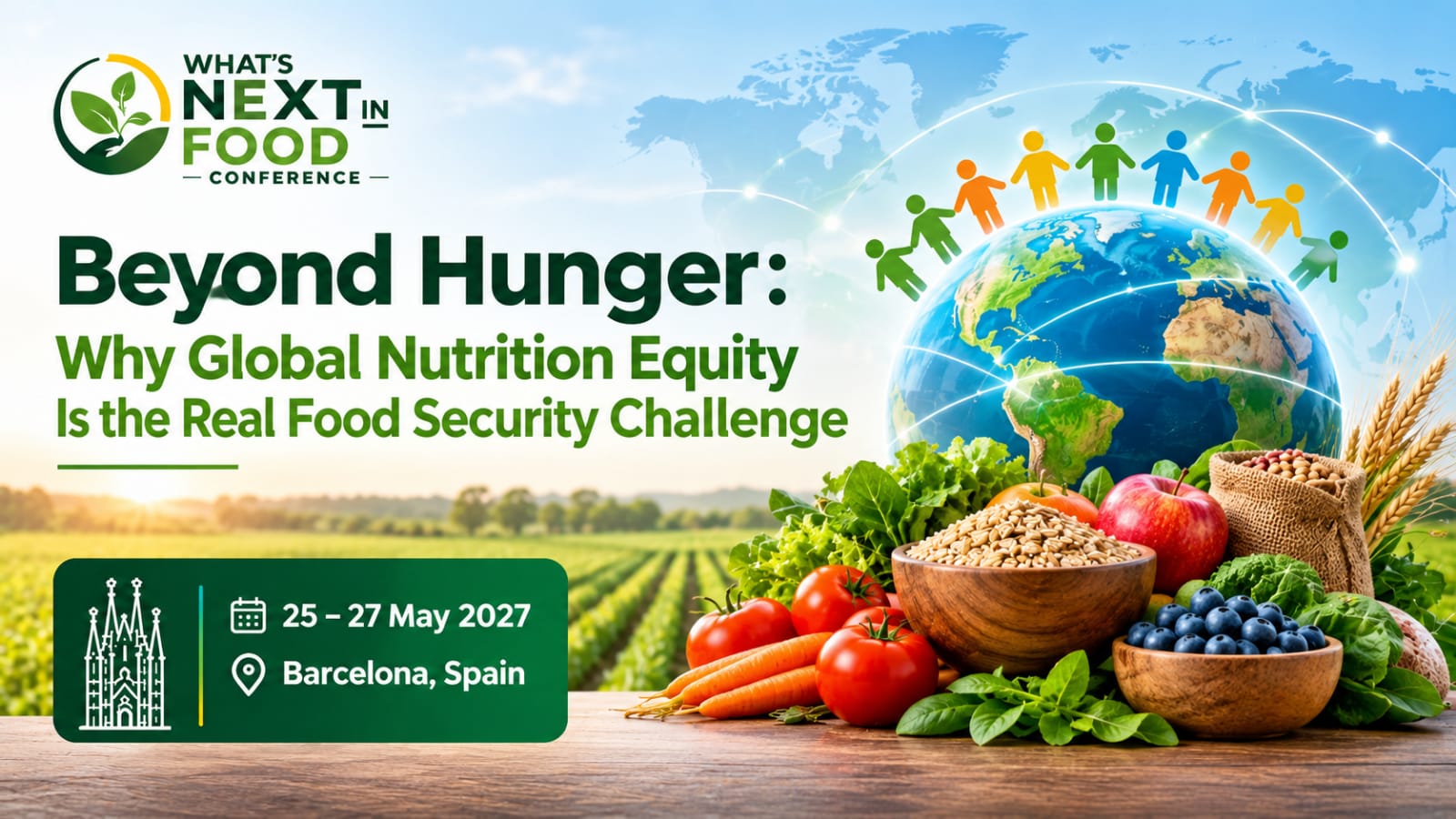
📅 25–27 May 2027
📍 Barcelona, Spain
Whether you want to attend, present research, exhibit, or partner, this is your opportunity to be part of the conversation shaping what the world eats next.
Register now:https://nextinfood.com