
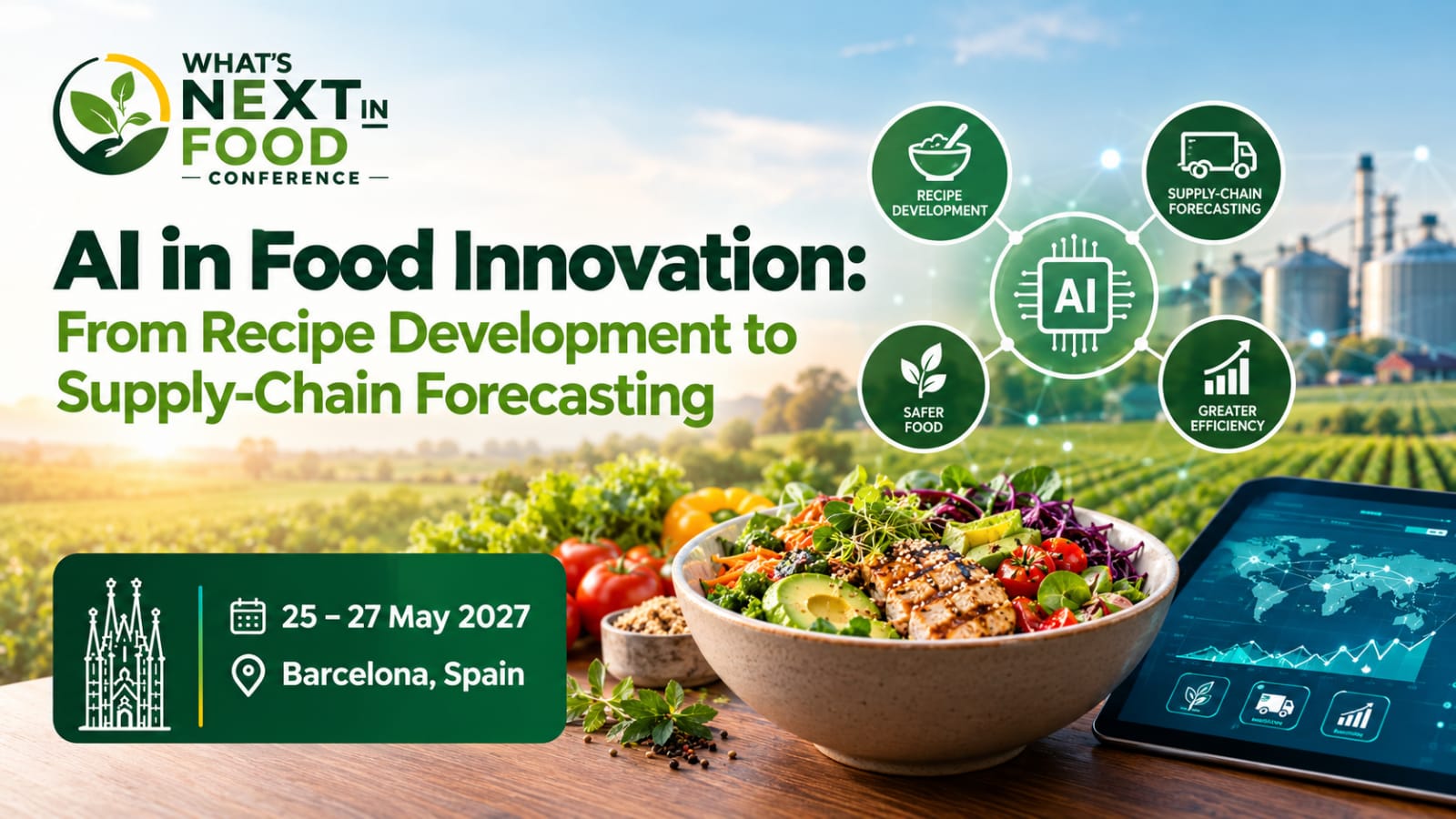
Artificial intelligence is becoming a practical engine of food innovation—not a distant concept. Across product development, manufacturing, retail, and logistics, AI is helping food companies create better products, respond to changing consumer preferences, and build supply chains that are more efficient and less wasteful.
Reinventing product development
Food innovation has traditionally relied on lengthy cycles of formulation, sensory testing, consumer research, and reformulation. AI is changing that process by analyzing large volumes of ingredient data, recipes, nutrition profiles, sensory information, and consumer signals.
AI platforms can identify emerging flavor and texture preferences, predict how ingredient combinations may affect taste and consumer appeal, and help R&D teams narrow formulations before physical testing. This can shorten development timelines, reduce trial-and-error costs, and support the creation of products aligned with health, sustainability, and convenience trends.
For example, AI can help brands identify rising demand for specific textures, ingredients, or flavor pairings by analyzing social conversations, menus, recipes, and purchasing patterns. These insights allow product teams to design around real consumer demand rather than assumptions.
Smarter, more resilient supply chains
AI’s value extends well beyond the laboratory. Food businesses operate in a highly perishable, weather-sensitive, and demand-volatile environment. Machine-learning models can combine historical sales, seasonality, promotions, weather patterns, and market signals to forecast demand more accurately.
Better forecasting helps manufacturers, retailers, and food-service operators align production and ordering with real demand. That reduces overproduction, excess inventory, stock-outs, and food waste—while improving availability for consumers. Research suggests that AI-driven demand forecasting can improve accuracy compared with traditional methods, although the results depend on data quality, model selection, and operating conditions.
AI also supports cold-chain management. IoT sensors can track temperature, humidity, and other conditions in storage and transport, while AI models analyze this data to predict spoilage risks and optimize logistics. This is particularly valuable for fresh produce, dairy, meat, seafood, and ready-to-eat products.
Reducing waste and improving safety
AI can make waste visible earlier in the value chain. Computer vision and sensor-based systems can detect defects, spoilage, contamination risks, and quality variations in real time, enabling faster intervention before products are lost.
When combined with traceability tools, AI can help businesses identify where losses occur, monitor product movement, and respond quickly to quality or safety issues. AI-enabled quality control and shelf-life prediction can therefore support both food safety and sustainability goals.
The most effective applications move decision-making upstream. Instead of managing surplus after it is created, companies can use AI to prevent it through better planning, inventory control, and early quality detection.
From pilot projects to system-wide impact
The opportunity is not simply to deploy AI tools in isolation. Food companies need connected data, clear use cases, and collaboration across R&D, procurement, manufacturing, logistics, and commercial teams.
Key priorities include:
•Using AI to identify consumer trends and accelerate product formulation.
•Improving demand forecasts across stores, distribution centers, and production lines.
•Deploying computer vision and sensors for quality inspection and spoilage detection.
•Integrating AI with cold-chain monitoring and traceability systems.
•Measuring results through reduced waste, improved forecast accuracy, and faster innovation cycles.
AI will not replace food scientists, farmers, or supply-chain professionals. But it can give them better information, earlier warnings, and more options for decision-making. In a food system facing climate pressures, shifting diets, and rising expectations for transparency, that capability is becoming essential.
Join the conversation at What’s Next in Food
Explore how AI is transforming food innovation, demand forecasting, and supply-chain efficiency—and connect with the leaders shaping the future of food.
Register now:https://nextinfood.com