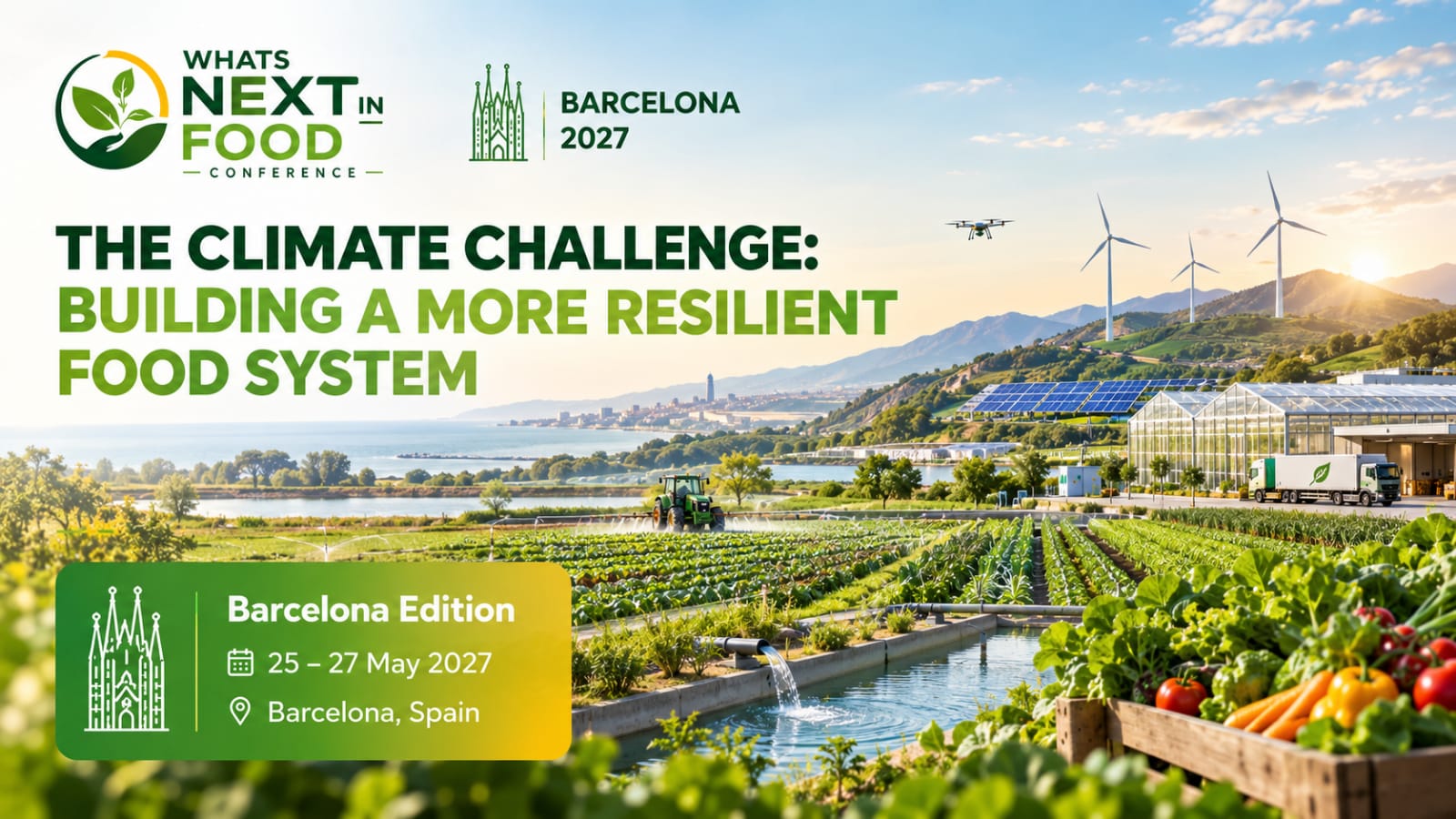
The future of food will be shaped by one question: can the global food system feed a growing population while operating within a changing climate?
Extreme heat, droughts, floods, wildfires and shifting rainfall patterns are already placing pressure on agriculture and food supply chains. These risks affect more than farms. They can disrupt the availability of essential ingredients, increase production and transport costs, damage infrastructure and make food prices more volatile.
For food companies, climate change is becoming an operational and strategic issue. Resilience is no longer limited to preparing for an unexpected disruption; it increasingly requires businesses to redesign how food is grown, processed, packaged, transported and consumed.
A system under pressure
The food system is exposed to climate risks at every stage of the value chain. Farmers face declining water availability, soil degradation, heat stress and changing pest patterns. Manufacturers must manage higher energy costs and interruptions to raw-material supplies. Retailers and foodservice businesses must respond to fluctuating prices and changing consumer expectations.
Europe is also strengthening its focus on climate-resilient food systems. Across the region, food producers and businesses are facing greater pressure to manage water scarcity, extreme weather, soil degradation and supply-chain disruption while reducing agricultural emissions. This is pushing the sector toward climate-smart farming, more resilient sourcing, efficient resource use and stronger traceability.
The risks are especially complex because food supply chains are interconnected. A Climate-related disruption in one region can affect global prices for grains, coffee, cocoa, fruit, edible oils or animal feed. Companies that rely on a narrow group of suppliers may be particularly vulnerable when weather conditions change rapidly.
Cutting emissions across the value chain
Reducing emissions requires action beyond a company’s own facilities. For many food and beverage businesses, the largest share of emissions comes from Scope 3 activities, including agriculture, ingredients, packaging, transport, retail and consumer use. In some cases, Scope 3 emissions can represent as much as 99% of a company’s total carbon footprint.
This makes supplier engagement essential. Food companies can work with farmers and producers to improve soil health, reduce fertilizer use, protect biodiversity and manage water more efficiently. They can also invest in lower-emission ingredients, renewable energy, efficient refrigeration, low-carbon logistics and packaging systems that use fewer virgin materials.
However, progress depends on reliable data. Companies cannot manage supply-chain emissions effectively if they do not know where those emissions occur or how they change over time. Better supplier reporting, traceability systems and common measurement standards will be central to credible climate action.
Adapting agriculture to climate risk
Mitigation alone will not protect the food system from climate impacts that are already occurring. Adaptation must become a parallel priority.
Climate-resilient agriculture may include:
•Drought-, heat- and salinity-tolerant crop varieties.
•Diversified farming systems that reduce dependence on a single crop.
•Precision irrigation and improved water-management practices.
•Agroforestry and soil-health programs.
•Better weather forecasting and early-warning systems.
•Local seed systems and stronger post-harvest infrastructure.
•Financial protection for farmers facing climate-related losses.
Research highlights the value of climate-resilient seeds, improved water and nutrient efficiency, circular bioeconomy models and stronger post-harvest systems. These measures can help protect yields while reducing pressure on land, water and energy resources.
Adaptation must also be locally appropriate. A farming strategy that works in a temperate region may not be suitable for a semi-arid area, a smallholder system or a coastal community exposed to salinity. Effective solutions should reflect local climate conditions, farmer resources, market access and cultural practices.
Tackling food loss and waste
Food loss and waste represent both a climate problem and a missed opportunity. When food is lost during production, storage, processing, transport or consumption, the water, land, energy and labour used to produce it are also wasted.
Organic waste sent to landfill can generate methane, a potent greenhouse gas. Better storage, cold-chain infrastructure, demand forecasting, packaging design and redistribution systems can help prevent food from being lost before it reaches consumers.
Where waste cannot be avoided, businesses can explore composting, anaerobic digestion, nutrient recovery and the use of by-products in new food, feed or industrial applications. Circular approaches can reduce emissions while creating additional revenue streams.
Making sustainability commercially viable
Building a climate-resilient food system requires investment in factories, packaging, data systems, suppliers and new products. However, inflation, regulatory uncertainty, high costs and limited supplier data are prompting companies to replace broad sustainability promises with more measurable, achievable goals.
The strongest strategies link environmental action with business value. Energy and water efficiency can reduce costs, resilient sourcing can limit shortages, and food-waste reduction can improve margins while strengthening long-term access to raw materials.
What comes next?
The climate challenge is reshaping the definition of food innovation. The next generation of solutions will not only focus on new ingredients or production technologies. They will also address how food systems use land, water, energy and resources.
The companies most prepared for the future will be those that can answer three questions:
•How exposed is our supply chain to climate risk?
•Where can we reduce emissions most effectively?
•How can we make climate action affordable and scalable?
Building a more resilient food system will require difficult choices, sustained investment and cooperation across borders. But it also creates opportunities to improve efficiency, strengthen farmer livelihoods, reduce waste and develop new markets.
The future of food will not be defined only by what the world produces. It will be defined by how intelligently, equitably and sustainably food is produced in a changing climate.
Explore the technologies and strategies shaping a more resilient food system at What's Next in Food by Next Business Media.
Reference
Leiding, B., Paulus, S., & Lehmann, D. J. — “The future of resilient food production—Current challenges and future opportunities.” Frontiers in Sustainable Food Systems, 20 February 2026.